


Mapping the Barriers to Our Good Life
Why the obstacles consumers face are built into the system and what it takes to see them clearly.
Created by Co-designers with lived experience
The content here was developed by the Making Rights Real Co-Design Group, a collective of 16 people from across Australia, including Victoria, NSW, South Australia, Tasmania, Western Australia, ACT, and Queensland.
We identify as people living with psychosocial disability or mental health challenges. We represent a diverse range of identities, including Trans, Non-binary, Queer, Pansexual, First Nations, and Culturally and Racially Marginalised (CARM) communities. Every insight here is a product of our collective wisdom and lived experience.
When you engage with this content, you aren’t just reading about human rights — you are seeing what happens when a group of consumers connects their deepest experiences to a vision of a fair and inclusive society. We hope that it offers language, tools, and inspiration to help make rights a lived reality in Australia. While you might not see your name on these pages, we hope you see your experiences.
Why does it feel like the system is working against us?
Many of us know the feeling. We reach out for help and come away feeling unheard, judged, or even harmed by the very services meant to support us. It is tempting to take that personally — to assume we didn’t try hard enough or explain ourselves well enough.
But these experiences are not random, personal failures. They are the predictable symptoms of how systems are designed. To change that, we have to stop treating each painful moment as a one-off and start looking beneath the surface at the structures and beliefs that produce these moments again and again.
Looking beneath the waterline
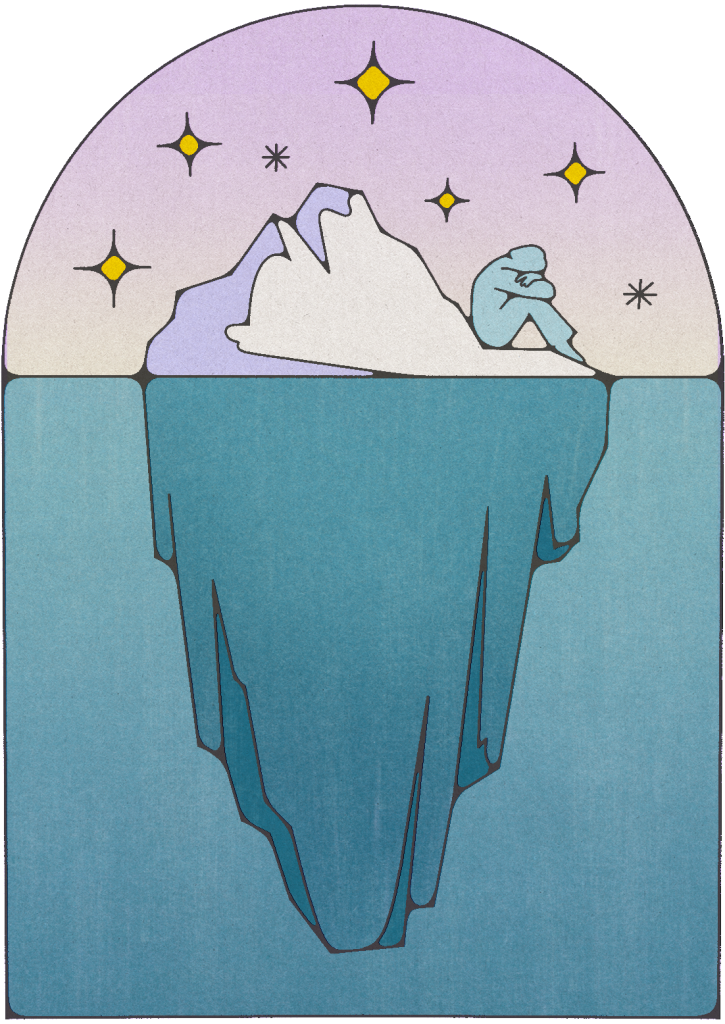
We use the Iceberg Model from systems thinking to make the invisible visible. Picture the mental health and community support system as an iceberg: only a small part shows above the water, while the largest and most powerful part sits hidden beneath it.
- Above the water — the events: The single things that happen — a dismissive comment, a rejected application, a moment of feeling unseen.
- Just below the surface — the patterns: The same events, over and over. Not one rejection, but the recurring grind of re-traumatising paperwork.
- Deeper — the structures: The policies, rules, and funding models that produce those patterns — such as a requirement to disclose detailed trauma before any support is offered.
- At the foundation — the mental models: The unspoken beliefs held by the people who run the system. These are what keep the structures in place.
When we only react to what is above the water, we get temporary relief. When we name the structures and beliefs below it, lasting change becomes possible.
What we found beneath the surface
Drawing on deep empathy interviews and co-design sessions, we mapped the barriers that keep people from living according to their rights. Each one connects a pain point we feel to the structure that causes it and the belief that holds it in place. A few examples:
- Reactive, crisis-only support: The system waits until we reach breaking point because funding rewards crisis intervention over continuous care, and because of a belief that “crisis is the only duty”.
- Re-traumatising bureaucracy: We document our trauma again and again to justify support because assessments are built around deficits, and because “paperwork is priority”.
- Punitive restrictions on life choices: We risk losing support if we marry or earn a small income because support is made conditional, and because of a belief that “poverty equals validity”.
- Decisions made for us: Professionals direct our lives on the assumption we cannot because the legal framework hands authority to professional titles, and because “formal knowledge is superior” to lived experience.
The full map — the complete table of pain points, structures, and mental models — is in the resource below.
Why naming the barriers matters
Naming a barrier does two things.
It shifts blame and ends shame.
When an application is rejected, it is easy to think, “My story wasn’t compelling enough.” Once we can name the deficit-based structure and the belief driving it, we can see that the rejection is a feature of the design not a flaw in us.
It makes advocacy precise. “My GP is always rushed” names an individual. “People are rushed because cost-cutting structures are driven by a belief that a lack of empathy is acceptable” names something a service or policymaker can actually change.
A note on the weight of this work
Mapping these barriers can be heavy. Naming systemic harm can bring back times we felt powerless.
If you have lived experience: pace yourself. You do not have to carry the system alone. This map exists to show that the system is the problem not us.
If you work inside the system: many good people work within harmful mental models, often inherited and rarely chosen. This is not about individual blame. It is an invitation to stay curious about the shifts that need to happen.
Understanding the Barriers to a Good Life
Download our resource.
Inside: the full Iceberg Model, the complete map of pain points, systemic structures, and mental models, and reflection prompts for consumers and stakeholders alike.
Where this leads next
Naming the problem is only the beginning. Once we can see the barriers clearly, the question becomes: what do we build in their place? That is the work of the Blueprint for Partnership and the Warm Entry — practical ways for stakeholders to move from managing people to supporting them to lead their own lives.
Blogs

When the Front Door is the First Harm
One consumer’s account of what happens when the intake process becomes the first harm — and a direct illustration of why ‘respect as a clinical metric’ is not an abstract principle but an urgent, measurable standard.
The Velvet Rope of Pity
When we experience a difficult interaction – like being pitied or dismissed—we are only seeing the event (the tip of the iceberg above the water). But beneath that surface lie systemic structures (the rules, policies, and gatekeeping) and, at the very bottom, mental models (the deep-seated beliefs that drive everything else).
The following story by Nicola-Jane le Breton illustrates what happens when we look “beneath the waterline” of a single interaction with a General Medical Practitioner (GP).
The Partnership Revolution
On moving from a cage of protection to a safety net of support.
The Expert in the Room is Me
The following story illustrates what happens when we look “beneath the waterline” of a psychiatric diagnosis.
The 28-Day Constraint: How DSP Rules Undermine the Right to Global Movement (Article 18)
Why is financial security conditional on staying in one place? JH, our lived experience writers, highlights a significant systemic barrier: the 28-day DSP (Disability Support Pension) travel limit. This piece examines how such rigid constraints infringe upon the rights of mental health consumers, creating a system where essential financial security is traded for curtailed movement.
Marriage or Money: How the DSP Partner Rule Violates the Right to Safety (Article 23 and 28)
Marriage or Money: How the DSP Partner Rule Violates the Right to Safety (Article 23 and 28)Author: JH Article 23 of the UN Convention on